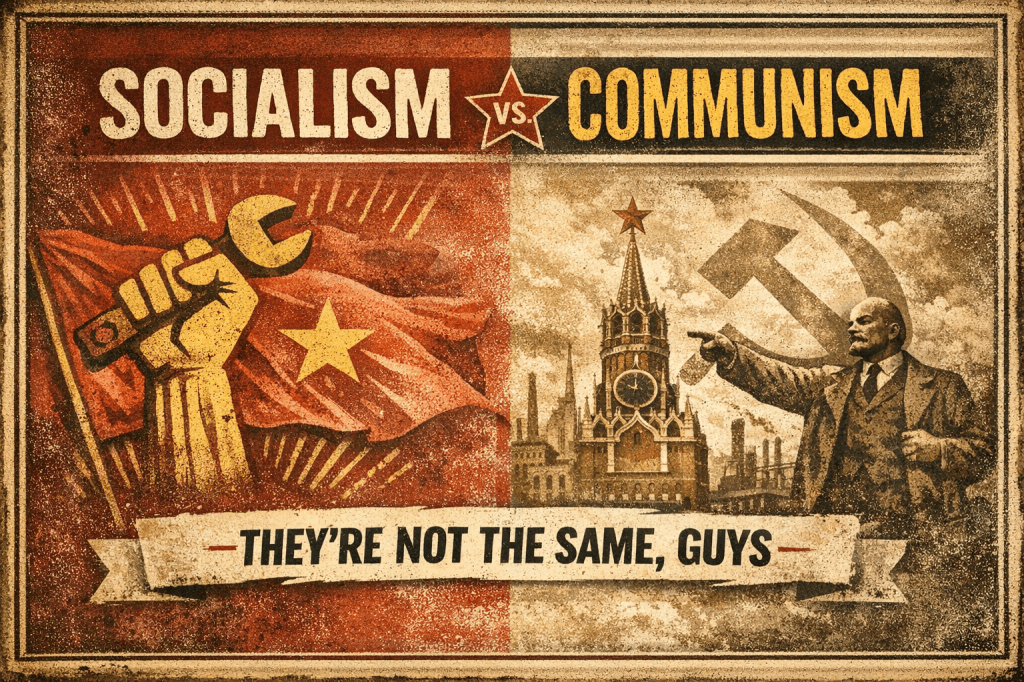
Let’s talk about two words that get tossed around in American politics like confetti at a toddler’s birthday party: socialism and communism. People use them interchangeably, incorrectly, dramatically, and sometimes with the same energy as someone yelling “witchcraft!” at a microwave.
So let’s break this down — with clarity, humor, and just enough chaos to keep it interesting.
First: Socialism and Communism Are Not the Same Thing
Are they related, sure — like cousins who show up to the same family reunion but have very different vibes.
Here’s the simplest way to understand it:
🌹 Socialism (big umbrella term)
A broad category of ideas that argue major industries should be collectively owned — by workers, communities, or the public — instead of by private corporations.
It includes a huge range of beliefs, from:
- democratic socialism
- social democracy
- cooperative economics
- Marxist socialism
- and more
Think of socialism as a spectrum, not a single system.
🔨 Communism (specific ideology)
Communism is a very specific political and economic theory that envisions:
- no private property
- no social classes
- no state (in the final stage)
- collective ownership of everything
Historically, countries that called themselves communist didn’t reach that stateless, classless end goal. Instead, they created one‑party states with heavy central control.
So yes — related. But no — not interchangeable.
So Why Do Americans Mix Them Up?
Because U.S. political culture has a long tradition of using “socialism” as a catch‑all insult for anything someone doesn’t like.
Here are the big reasons:
🔥 1. The Cold War Burned These Words Into Our Brains
For decades, Americans were taught that:
- socialism = communism
- communism = enemy
- enemy = bad
Nuance was not invited to the party.
📺 2. Media Soundbites Love Oversimplification
“Communism” and “socialism” get thrown around on TV as if they’re synonyms, because explaining the difference takes longer than a 12‑second segment between commercials. And let’s be honest, do you really think they want us to know the difference between the two? Or do they want us to keep misusing these words, walking around acting like we are the pro-historian’s?
🗳️ 3. U.S. Politics Uses the Terms as Weapons
Some commentators use “socialist” to describe:
- public libraries
- fire departments
- Medicare
- student loan forgiveness
- roads
- literally anything involving taxes
It’s less about accuracy and more about emotional reaction.
🧠 4. Most Americans Never Learned the Actual Definitions
Civics education in the U.S. tends to be:
- light on political theory
- heavy on “America good, communism bad”
- allergic to nuance
So people grow up thinking socialism = communism = dictatorship.
🧭 Why the Confusion Matters
Because when we blur the lines, we shut down real conversations.
Here’s what gets lost:
- Social democracy (like in Nordic countries) is not communism.
- Democratic socialism works within democracy, not against it.
- Communism is a specific ideology with a specific end goal.
- Socialism is a broad category with many democratic versions.
When everything gets labeled “communism,” we can’t talk about:
- healthcare reform
- labor rights
- public services
- economic inequality
- or literally any policy involving collective action
It becomes political static — loud, emotional, and not very helpful.
🧩 A Quick Cheat Sheet (Because We Love a Good Table)
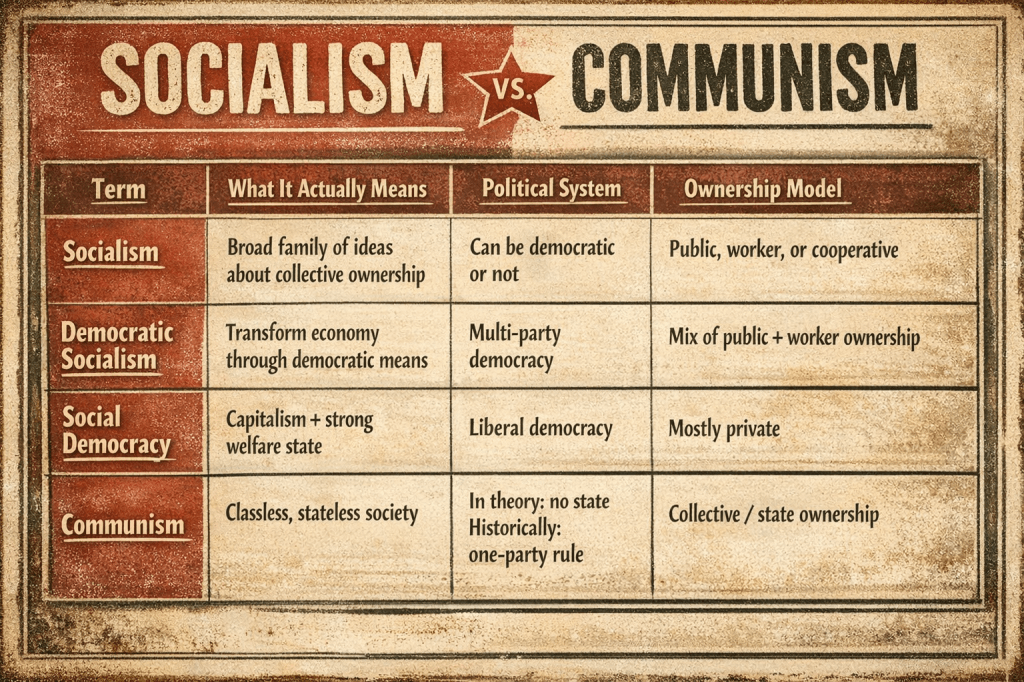
Closing Thoughts
If you’ve ever felt like political labels get thrown around like glitter in a windstorm — you’re not wrong. But understanding the difference between socialism and communism helps us cut through the noise and actually talk about what policies mean, not just what they’re called.
And honestly? The more we understand, the less likely we are to get bamboozled by dramatic headlines or Facebook uncles who think the post office is communism.

 Katieokiedokie
Leave a comment