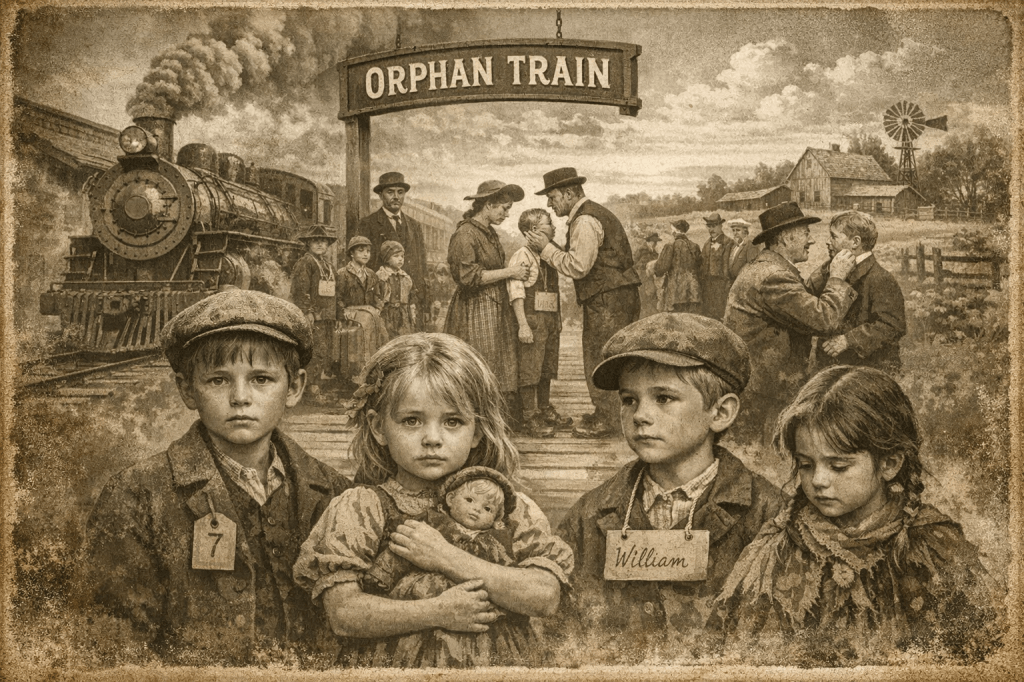
If you think modern America has commitment issues, wait until you hear about the time we literally shipped children across the country like Amazon packages and hoped for the best. Buckle up, babes — this is the Orphan Train Movement, a chapter of U.S. history so wild, so heartbreaking, and so rarely taught that it feels like someone tried to bury it under the nation’s metaphorical floorboards.
Spoiler: they almost succeeded.
🌆 The Problem: 19th‑Century Cities Were a Hot Mess
Picture New York City in the mid‑1800s. Now remove sanitation, child welfare laws, and any concept of “maybe kids shouldn’t work 14‑hour shifts in a factory.”
Between immigration waves, disease outbreaks, poverty, and the Civil War, cities were overflowing with:
- Homeless children
- Abandoned infants
- Kids whose parents died in epidemics
- Kids whose parents were alive but too poor to feed them
- Kids working in factories, docks, and sweatshops
By the 1850s, an estimated 30,000 children were living on the streets of NYC alone. Newspapers called them “street Arabs” and “urchins,” because apparently compassion was on backorder.
Enter: one man with a big idea.
👔 Meet Charles Loring Brace: The Man With the Plan (and the Beard)
Brace was a minister and reformer who looked at the chaos and said, “Okay, but what if we… mailed the children?”
He founded the Children’s Aid Society in 1853 and proposed a bold solution:
👉 Send city kids to rural families in the Midwest
The logic was very 19th‑century:
- Rural families needed extra hands
- City kids needed food, shelter, and structure
- Farms were wholesome
- The Midwest was basically America’s “reset button”
Thus began the Orphan Train Movement, the largest child relocation effort in U.S. history.
🚂 All Aboard: How the Orphan Trains Worked
From 1854 to 1929, more than 200,000 children were placed on trains and sent westward to states like:
- Indiana
- Illinois
- Kansas
- Iowa
- Missouri
- Nebraska
- Minnesota
Some were true orphans. Many were not. Some had one living parent. Some had two. Some were simply poor.
The Process (aka: “The Child Shuffle”)
- Children were gathered from streets, orphanages, and poorhouses.
- They were cleaned up, dressed, and given a tag with their name.
- They boarded trains with agents from the Children’s Aid Society.
- At each stop, townspeople gathered to “select” children.
- Kids were inspected like livestock — teeth checked, muscles squeezed.
- Families signed a contract promising food, shelter, and schooling.
- The train moved on to the next town.
Some kids found loving homes. Others became unpaid labor. Some were abused. Some ran away. Some thrived. Some never recovered.
It was a national lottery with children as the tickets.
🧒 Who Were the Children?
They were:
- Irish immigrants
- German immigrants
- Italian immigrants
- Jewish children
- Black children (though far fewer were placed due to racism)
- Native children (often taken from families without consent)
- American‑born kids from poor families
Ages ranged from toddlers to teenagers. Siblings were often separated. Some never saw each other again.
🏡 What Happened When They Arrived?
This is where the story splits into two Americas.
🌼 The Good Homes
Some families truly wanted children. They adopted them, loved them, educated them, and gave them stable lives. Many orphan train riders grew up to become:
- Teachers
- Farmers
- Business owners
- Politicians
- Parents who broke the cycle
These stories exist — and they matter.
🌑 The Not‑So‑Good Homes
Other families wanted:
- Farm labor
- Housemaids
- Babysitters
- Cheap workers
Some children were:
- Overworked
- Underfed
- Beaten
- Denied schooling
- Treated as servants, not sons or daughters
And because child welfare laws didn’t exist yet, oversight was… let’s call it “aspirational.”
📜 The Legacy: A Complicated, Haunted Family Tree
The Orphan Train Movement ended in 1929 as social work, foster care, and child protection laws improved.
But its impact is massive:
- It shaped the early foster care system
- It influenced adoption laws
- It scattered family lines across the Midwest
- It left thousands of descendants with fragmented genealogies
- It raised ethical questions we still wrestle with today
Many orphan train riders never spoke of their past. Shame, trauma, or simply wanting to move on kept their stories quiet.
Only in the last few decades have historians and descendants begun piecing together the truth.
🕯️ Why We Don’t Learn This in School
Because it’s messy. Because it’s not a clean “America saved the day” narrative. Because it forces us to confront:
- Poverty
- Immigration prejudice
- Child exploitation
- Government neglect
- The myth of the “good old days”
And because the line between “rescue” and “removal” is thin — and uncomfortable.
💬 Final Thoughts: America’s Forgotten Children Deserve to Be Remembered
The Orphan Train Movement is one of those stories that makes you sit back and whisper, “Wow… we really did that.”
It’s a reminder that:
- Good intentions can cause harm
- Systems matter
- Children deserve protection, not experiments
- And history is always more complicated than the sanitized version we got in 8th grade social studies

 Katieokiedokie
Leave a comment